

There’s an old saying, “Money can’t buy happiness.” But research has repeatedly found that this isn’t actually true — people who make higher salaries are generally happier and have higher levels of wellbeing. Income and happiness are directly related. Which may make you wonder: “Then why am I so miserable, even though I make more than enough money?”
The answer to that is complex. Generally, higher income does lead to greater happiness. It makes sense: when your basic needs are met and you have more control over your time, stress decreases. But a newer study found that for others, especially those who are already unhappy, money might not change much at all.
You can earn a high salary and still feel stuck, anxious, or dissatisfied, especially if you hate your job. Income and happiness are directly related for some, to a certain extent — but not for everyone, and not under every condition.
The role of money in happiness
Money plays a clear role in happiness and well-being.
Research shows that, generally, when income levels rise, people report greater happiness and life satisfaction. This effect is most obvious at lower income categories, where people are under enormous stress just trying to make ends meet. When you no longer worry about paying rent, affording groceries, or having enough saved for emergencies, it’s a given that your stress decreases (and emotional well-being rises).
But the relationship between income and happiness doesn’t stop once basic needs are covered. More recent research suggests that happiness continues to rise with income, even at higher income levels.
A famous 2010 study (Kahneman) found that emotional well-being plateaued at around $75,000 in U.S. household income. But in 2021, Matthew Killingsworth published a study showing that happiness continues to rise with income, even well beyond six figures. In other words, he found that there is no upper limit to how much money you could make and still see returns on happiness levels.
So which results are true?
In 2023, the authors of the two studies came together to publish new research, which resolved their disagreement. They determined that happiness does, generally, continue to rise with income — but not for everyone.
They found that for the majority of people, more money is associated with greater happiness. But for the least happy — roughly the bottom 20% — more income doesn’t really help. Once unhappy people reach around $100,000, their happiness stalls, no matter how much higher their salary climbs. This means that income and happiness are strongly linked for most, but not all.
Does money actually make you happier? Or does it cause more stress?
These results are nuanced. Basically, more money both can and can’t buy happiness. It depends on how happy (or, rather, unhappy) you were in the first place.
For many people, higher income leads to increased happiness because it reduces daily stressors and gives them more control over their lives. But money can also increase stress. Executives with high salaries often face heavier workloads and higher levels of responsibility. You might also feel like you have less freedom. If these factors lead to burnout or dread, then more money could make things worse, not better.
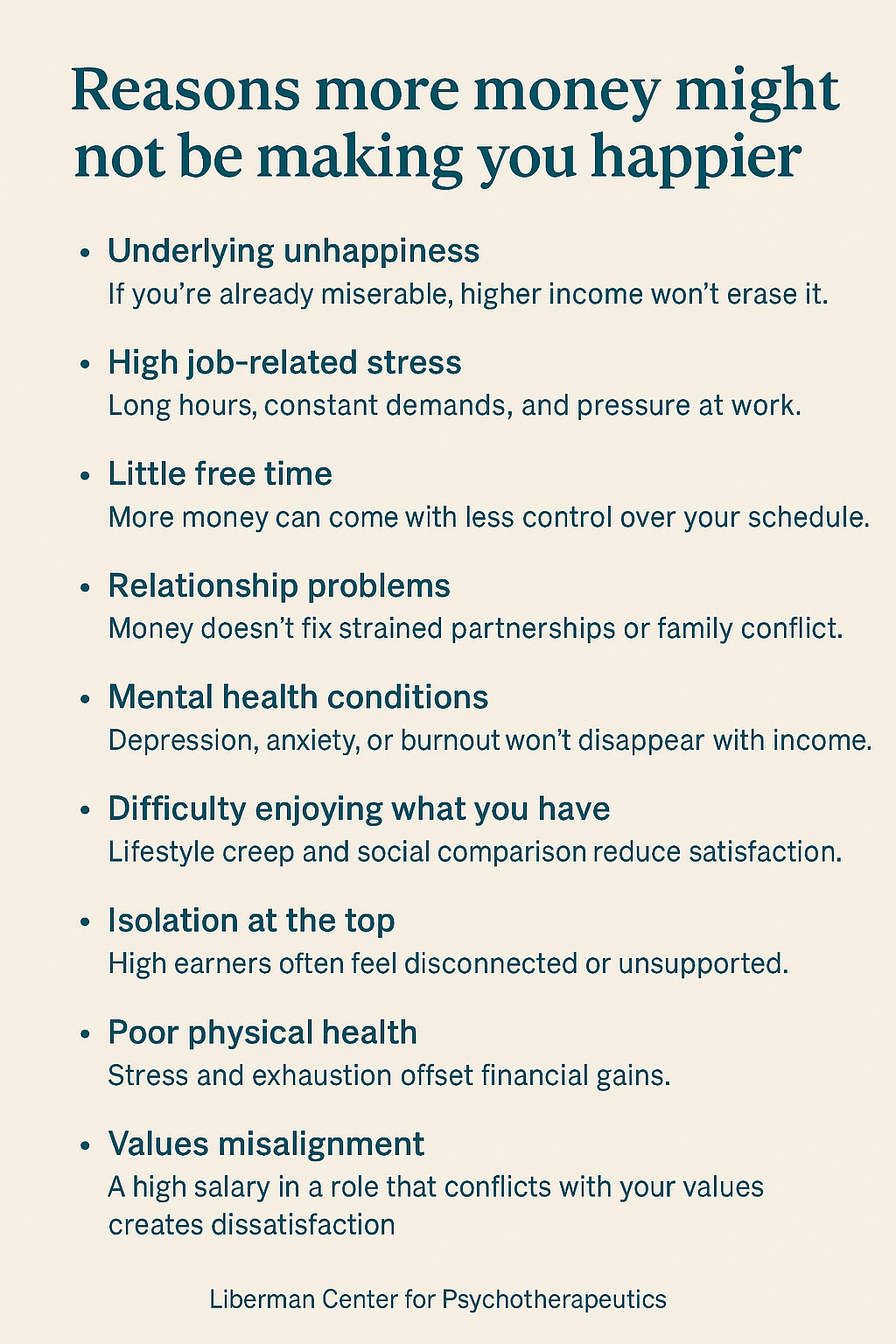
This explains why some people with very high incomes still feel deeply dissatisfied. This is valid, too. Money might insulate them from certain problems, but it also increases stress, and doesn’t erase the underlying unhappiness that they started with.
What salary is enough to be happy?
Unfortunately, there isn’t a single number that magically guarantees happiness. The earlier study suggested that happiness plateaus at $75,000, adjusted for inflation (around $111,000 today). Many people used that number as a guide, but we now know it isn’t true.
What salary is “enough” to be happy depends on multiple factors: cost of living in your area, your personal values, and whether your needs are met. Someone living in a lower cost-of-living area may feel comfortable with far less money than someone in New York City or San Francisco. For others, even a high six-figure salary might not be worth the constant stress of their job.
In general, if you make enough to have a comfortable lifestyle — to not worry about the daily costs of living — but still find yourself unhappy, then it may be time to consider whether it’s really about the money.
What if I make a high salary, but I’m miserable?
Many high-earning professionals feel unhappy, even as they continue to perform at the top of their fields. It can be frustrating and demoralizing to work so hard for so long to move up in your career, only to find that you’re still not happy.
Here are some steps to consider if you’re in this position:
- Identify the root of dissatisfaction — Take an honest look at what causes your unhappiness. Are they factors related to your work itself, like the long hours, responsibility and pressure, or isolation? Is it problems at home, that seem to continue despite how accomplished you are in your career? When you know what’s causing your unhappiness, then you can start to take steps to address it.
- Recognize that money might not help — Research shows that money increases happiness for most, but not for those who are already deeply unhappy. If you’re in that group, a raise or a new job with a higher salary won’t address the dissatisfaction. It may be time to reevaluate your strategy.
- Use income to support your well-being — You can “buy” happiness — or something like it — by using money to reduce stress. For example, you might consider investing in therapy, coaching, or other forms of mental health support. You can pay for services that give you back time, like a cleaning service or virtual assistant, or take a vacation sabbatical if possible.
- Get mental health support — If you’ve felt unhappy for a long time, despite everything looking great from the outside looking in, there might be something else going on. It could be that your life isn’t aligned with your true values. Or you could be experiencing an underlying mental health condition, like depression. It’s OK — these conditions are treatable. But if you don’t address them, they’re likely to only get worse. Mental health support can help you
High income brings security and opportunities, but it doesn’t guarantee happiness. If you’re miserable despite all the promotions and raises, it’s possible that the solution isn’t more money. You may need to make changes that address the real, underlying causes of your unhappiness.
Mental health treatment for high-performing individuals in NY and NJ
At the Lieberman Center for Psychotherapeutics, we deeply understand the complex relationship between income and happiness. You can be both grateful for your comfortable lifestyle and continue to have a sense of overall dissatisfaction in your life.
If you’re feeling like more money is only causing more problems for you, and you want to figure out how you can truly become happy, get in touch. We can schedule a free discovery call and talk about ways our mental health services — including therapy and medication management — can help.