

Author: Brad Lieberman, PMHMP-BC, is a board-certified psychiatric nurse practitioner providing integrative psychiatry in NYC. A former attorney trained at Columbia and Johns Hopkins, he brings analytical rigor and a level of advocacy and detail rarely found in mental healthcare.
High-achieving men with depression (major depressive disorder) often live in a way that convinces everyone around them that things are fine. Your work is getting done, your routine is intact, and you may be just as productive as ever. On the surface, the function looks solid. Maybe no one notices that anything is off.
But high-functioning depression is still depression, and you still deserve treatment. People with depression aren’t always “falling apart.” It affects high-achieving men who appear to be composed — and it can go unnoticed for years.
The Lieberman Center for Psychotherapeutics provides depression treatment in NYC for high-achieving professionals who are looking for more clinically sophisticated care. Schedule a free consultation now.
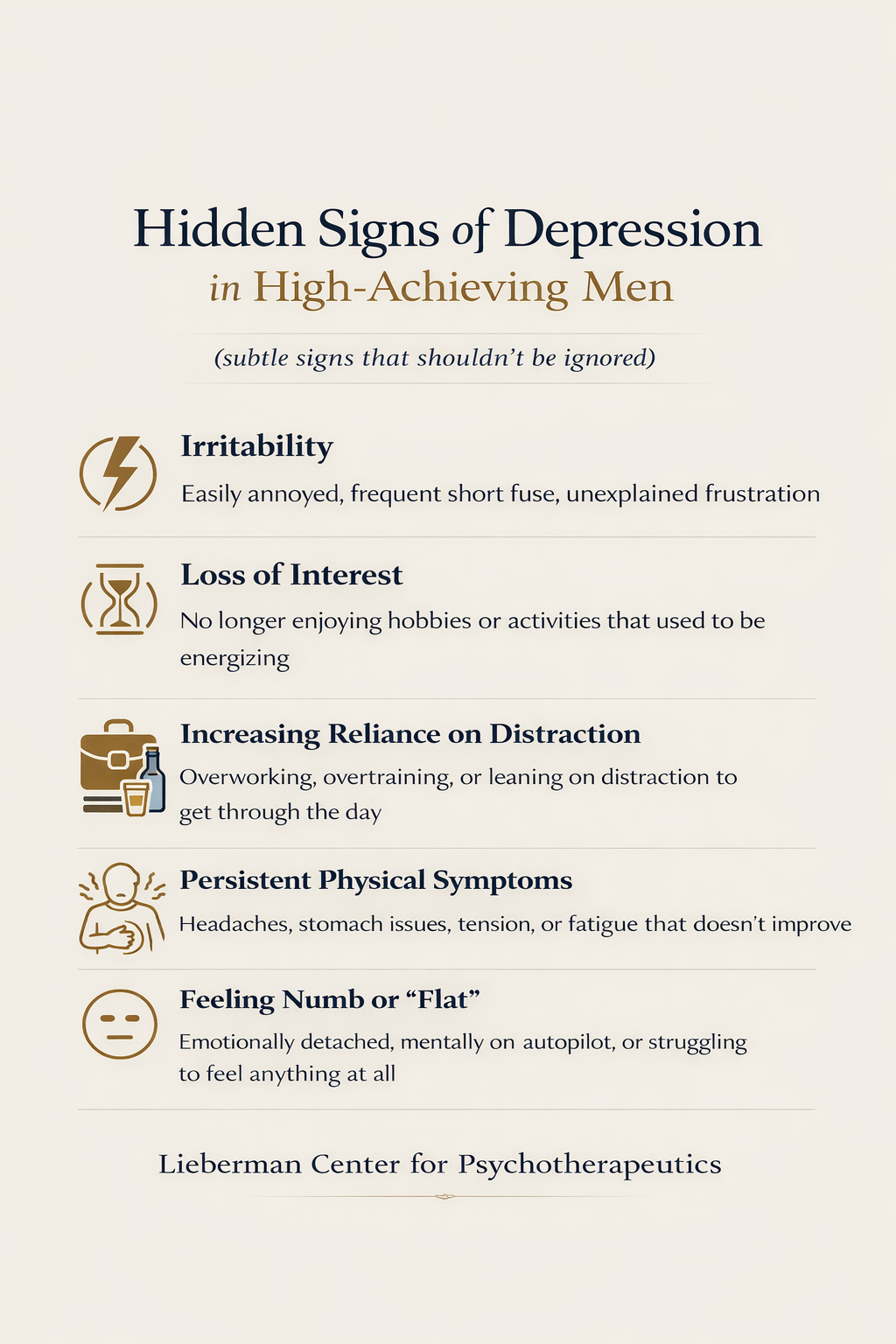
What are the symptoms of depression in high-achieving men?
High-functioning depression often doesn’t look like what most people associate with major depression. Many men with depressive symptoms still wake up early, go to the gym, take care of their families, and exceed expectations at work. Your symptoms might be more subtle — but they can still start to erode your well-being over time.
You might not feel sad or withdrawn. Instead, you might notice symptoms like:
- Persistent irritability or a short temper that feels out of character. For example, you might lash out at your spouse or kids more often or get into more conflicts with your colleagues.
- Losing interest in things that once felt energizing. You might generally not “feel” like doing anything, even when you have days off.
- Increasing reliance on work, exercise, alcohol, or other distractions to get through the day. For example, you might spend hours playing video games or work more overtime hours. You just don’t want to be alone with your thoughts.
- Physical symptoms like headaches, tension, stomach discomfort, or exhaustion that don’t improve and can’t be explained by other medical conditions.
- Feeling mentally “flat” even when life looks objectively good. You might not be able to put your finger on anything specific that’s “wrong,” but you can’t shake the sense that something is lacking.
Many men also experience depression and anxiety at the same time, which makes it even harder to recognize what’s actually going on. And because high achievers are good at compensating, the depressive disorder can get worse and worse, in silence, until it becomes severe depression.
Depression in men needs to be taken seriously
Just because you aren’t completely incapacitated by depression doesn’t mean that your symptoms shouldn’t be taken seriously. Men are four times more likely to die by suicide. Nearly 80% of all suicide deaths involve men.
Often, this is because depression in men often goes undetected or dismissed as “just stress.” Research also shows that men tend to experience more physical symptoms of depression, which means the signs can be misattributed to overwork or aging. This leads many men to delay or even refuse getting needed treatment.
Depression is a medical condition, not a personality flaw. You can’t “willpower” your way through it. It biologically affects mood, cognition, energy, and the brain systems responsible for motivation and reward.
Unfortunately, high achievers often ignore early warning signs because they can still function at a high level. This is what can make high-functioning depression so uniquely dangerous. It can be easy to convince others, and even yourself, that you’re “fine.”
But functioning isn’t the same as feeling well. You deserve to actually enjoy your life. And depression, when it’s left unaddressed, typically gets worse. In some cases, it can increase your risk for developing more serious mental health conditions.
When to seek help
Feeling “down” occasionally is part of being human, and you might not necessarily need professional treatment. But when your symptoms haven’t gone away, or when the pressure you’re under stops matching your internal capacity, it’s time to take your mental health seriously.
Fortunately, depression (as well as other mood disorders like bipolar disorder) is highly treatable. Evidence-based treatment methods have decades of research behind them.
The treatment of depression works best when you receive a comprehensive evaluation — the kind that looks at your full psychiatric and medical picture, your physical, emotional, and behavioral symptoms, your lifestyle, and your history. After this, an individualized treatment plan can be created to make sure you’re receiving the right combination of care.
A mental health professional can walk you through the treatment options that are most likely to be effective for your symptoms. They can also help distinguish depression from things like anxiety disorders, post-traumatic stress disorder, and forms of depression related to hormonal or medical factors.
Psychiatry
Medication is a part of depression treatment for many people. It can address the biological side of depressive symptoms. The most commonly prescribed antidepressant medications are selective serotonin reuptake inhibitors (SSRIs). Some people with treatment-resistant depression, or depression that doesn’t respond to first-line treatments, may benefit from other types of medications (like antipsychotics).
Psychotherapy
Psychotherapy is not just like talking to your friends. An experienced therapist can help you understand how long-standing patterns, as well as your life experiences (including trauma), have influenced your mental health. Cognitive behavioral therapy and other evidence-based modalities can improve mood regulation and reduce depressive symptoms. Individual therapy is often the first-line treatment for depression.
Other integrative methods
Integrative approaches can address biological and lifestyle factors that are often related to depression. Effective treatments include :
- Nutritional testing & counseling
- Sleep optimization
- Light therapy (for depressive disorders related to seasonal changes)
- Stress reduction strategies
- Genetic testing
Find depression treatment in NYC
If you’re experiencing symptoms that feel like they could be related to depression — or if you’ve noticed the early sign that something isn’t right — there is clinically grounded and effective care available.
The Lieberman Center for Psychotherapeutics offers a higher standard of clinical care that helps you get to the root of depression symptoms. We offer integrative psychiatry services, including medication management, therapy, and laboratory testing for depression and other psychiatric disorders. We specialize in working with high-achieving professionals who are seeking treatment for depression that actually works.
Get depression treatment in NYC. We also have convenient office locations in Westchester County and Long Island. Schedule a free consultation today.