

Author:Brad Lieberman, PMHMP-BC, is a board-certified psychiatric nurse practitioner providing integrative psychiatry in NYC. A former attorney trained at Columbia and Johns Hopkins, he brings analytical rigor and a level of advocacy and detail to his mental healthcare.
You’re snapping at your family more and getting into conflicts at work. You experience intense road rage during your commute. Anger is a normal and healthy emotion, but when it becomes unmanageable, it can start to have negative effects on your life.
There could be a hidden cause behind your angry outbursts: an anxiety disorder. The typical signs of anxiety include things like excessive worrying and restlessness. But we have scientific research showing that people who live with anxiety disorders are also more likely to experience anger and aggression.
If you’ve been feeling more irritable lately, then what you need may not be an anger management class — you may benefit more from seeing an anxiety therapist in NYC.
Can anxiety cause anger?
Yes, anxiety can cause anger in many people, and it’s often an underrecognized sign. Irritability is recognized as a core symptom of generalized anxiety in both children and adults. Anger may often be a sign of anxiety in men, in particular.
Numerous clinical studies have found that anxiety and anger are closely linked.
- One study found that both trait anger (being a generally angry person) and angry outbursts were more common in people with anxiety disorders, especially generalized anxiety disorder, panic disorder, and social phobia. People with co-occurring depression and anxiety experienced the most anger.
- Nearly 70% of adolescents with an anxiety disorder experienced angry outbursts, compared with less than 50% of their non-anxious peers. Over 1 in 5 anxious teens live with intermittent explosive disorder (a mental health condition characterized by explosive anger).
- People with social anxiety disorder were found to spend more time throughout the day feeling angry (and less time feeling happy and relaxed).
So while it may not necessarily be a direct cause, we have plenty of evidence to suggest that anxiety can lead to anger for many people. Of course, not all anger issues are connected to anxiety. But usually, it’s worth looking at all potential causes to address the problem at its root.
How symptoms of anxiety and anger are connected
In many ways, anxiety and anger have a bidirectional relationship, meaning that each can affect the other. Anxiety can lead to increased anger, but feeling angry more frequently can also be a risk factor for anxiety disorders.
Brain changes (fight or flight response)
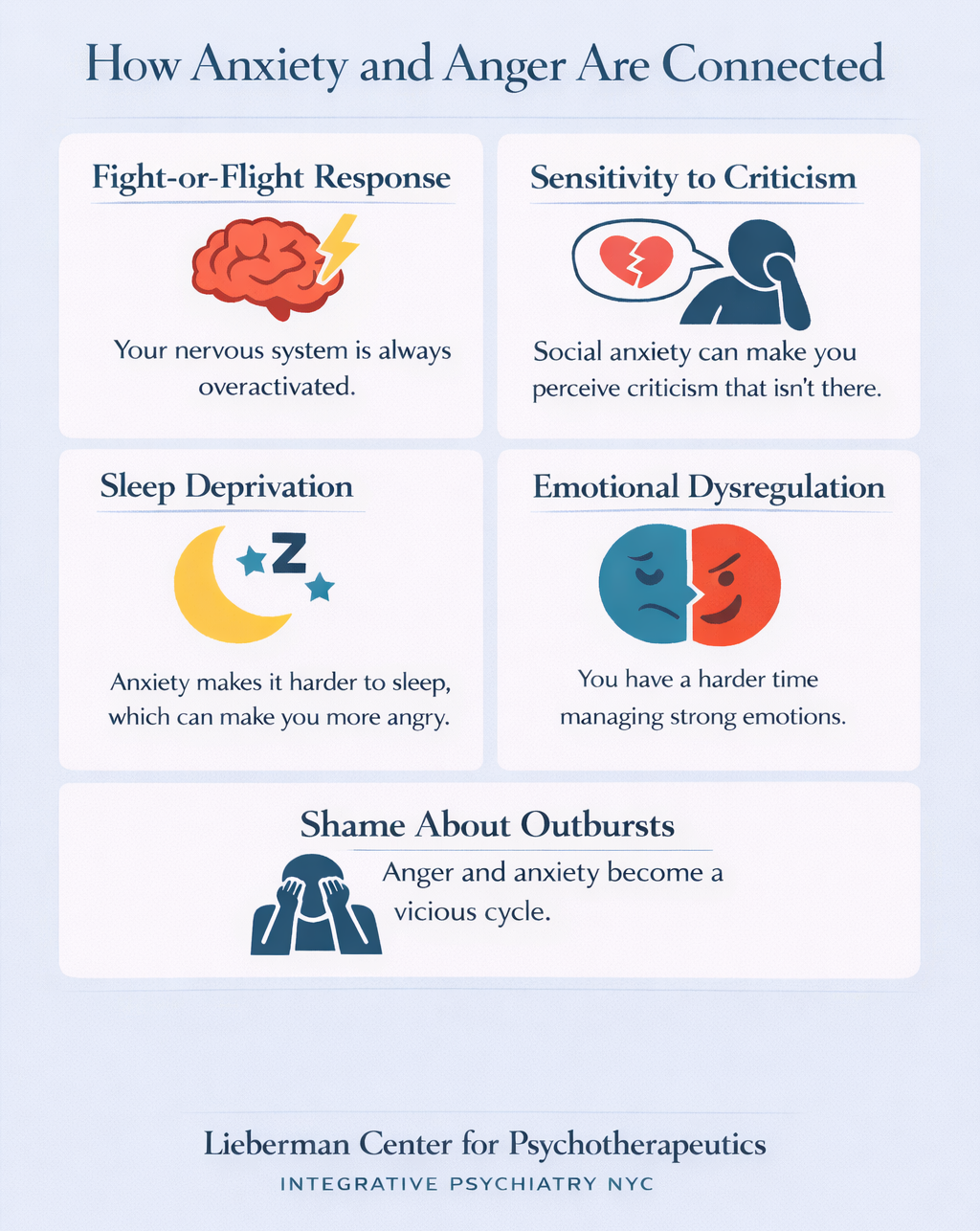
When you live with chronic anxiety, your nervous system is frequently activated. The fight-or-flight response — which is meant to protect you from danger — becomes overactive, and releases stress hormones like cortisol and adrenaline that prepare your body to react quickly.
Individuals with anxiety may live in a perpetual state of fight-or-flight. This means that you interpret neutral situations as threatening and may feel constantly on edge. When your body is primed for danger, anger can become the fastest and most accessible response — especially when you feel trapped or out of control.
Social anxiety disorder and criticism
People with social anxiety tend to be more likely to perceive criticism and rejection, even when it isn’t there. For example, a neutral facial expression can feel judgmental. Constructive feedback at work can register as humiliation. Over time, this heightened sensitivity can create defensiveness that shows up as irritability or anger.
Anger, in this context, can function as a protective response. If you feel judged or exposed, your mind may move quickly into self-defense. That reaction may look like snapping at someone or withdrawing socially due to resentment.
Sleep deprivation and mental health
Anxiety often disrupts sleep. Racing thoughts can make it difficult to get restorative rest. And when you’re sleep-deprived, your overall mental health can get much worse.
Sleep deprivation significantly lowers emotional tolerance. Research consistently shows that poor sleep impairs the brain’s ability to regulate emotion, particularly in the prefrontal cortex — the region responsible for impulse control. When you’re exhausted, everyday frustrations like financial worry can feel amplified, and your threshold for anger becomes much lower.
Emotional dysregulation
Many anxiety disorders involve difficulty tolerating intense emotion. This is called emotional dysregulation. When worries or anxious feelings come up, it can feel almost unbearable. If you already live with emotional regulation challenges, you may be less likely to be able to manage your anger as well.
Anger may also become a secondary emotion that masks anxiety. For some people, it feels more powerful and more controllable than fear. Instead of sitting with vulnerability, the nervous system may convert it into aggression.
Embarrassment about angry outbursts
After an angry reaction, many people with anxiety experience intense shame. They replay what they said (and didn’t mean) and fear long-term damage to their relationships or reputation. That rumination can create more anxiety, which then increases irritability the next time stress arises.
In this way, anger and anxiety can become a cycle. Anxiety can lead to increased anger, but acting out in anger can cause anxiety as well.
Coping with anxiety when it makes you angry
There are many healthy ways to cope with anxious feelings and anger that may come up in your everyday life.
Try:
- Slowing down your nervous system with breathing exercises that activate the parasympathetic (relaxation) response
- Building awareness of early physical cues (tight jaw, clenched fists, racing heart) before anger escalates
- Improving sleep hygiene to stabilize emotional reactivity
- Removing yourself from the triggering situation while you use coping skills to calm your nervous system
- Limiting caffeine and alcohol, which can heighten both anxiety and irritability
When to seek mental health treatment for anger and anxiety
Most people who live with an anxiety disorder benefit from professional mental health treatment. Feeling anxious, angry, or both sometimes is natural and healthy. These emotions can serve to protect us.
But if you feel this way on a daily basis, or if intense anger is getting in the way of living the life you want, then anxiety treatment can help.
It may be time to see a therapist or psychiatrist if:
- Your feelings of anger feel overwhelming, to the point where you feel completely consumed by them and find them difficult to control
- You’re finding it difficult to navigate even minor relational conflicts without becoming angry
- Anger is getting in the way of your work performance
- You become so angry that you get caught in physically dangerous situations (like fights)
- Your loved ones have expressed concern about your anger outbursts, or you’re starting to (even unintentionally) hurt the people you love
- Your anxious or angry thoughts are causing you to feel like you want to hurt yourself or end your life
If you are experiencing thoughts of self-harm or suicide, call or text 988 to reach the Suicide & Crisis Lifeline. If you are in immediate danger, call 911 or go to your nearest emergency room.
Work with an anxiety therapist in NYC
The relationship between anxiety and anger is complex. If you (or someone you love) are dealing with unexplained anger or aggression, it could be a sign of underlying anxiety (or another psychiatric disorder). And you deserve support, not judgment.
If you’re looking for an anxiety therapist in NYC, let us help. At the Lieberman Center for Psychotherapeutics, we offer integrative psychiatry services for people with anxiety. We look beyond surface symptoms to understand the biological, psychological, and lifestyle factors contributing to your symptoms. Schedule a free consultation. We have convenient office locations in NYC, Long Island, and Westchester County.