

Stress is a normal part of life in a fast-paced city like New York City, and it makes sense. Tight deadlines and long days are common here, especially if you’re in a high-pressure role. Many New Yorkers expect a certain level of pressure.
But burnout is different. It develops when stress stops being temporary and starts affecting how you think and function. You could still be performing at a high level, but that doesn’t mean you’re doing well internally.
You can’t work your way through burnout on your own. Noticing the signs and taking action early gives you a chance to recover from work stress and burnout before the strain becomes harder to reverse.
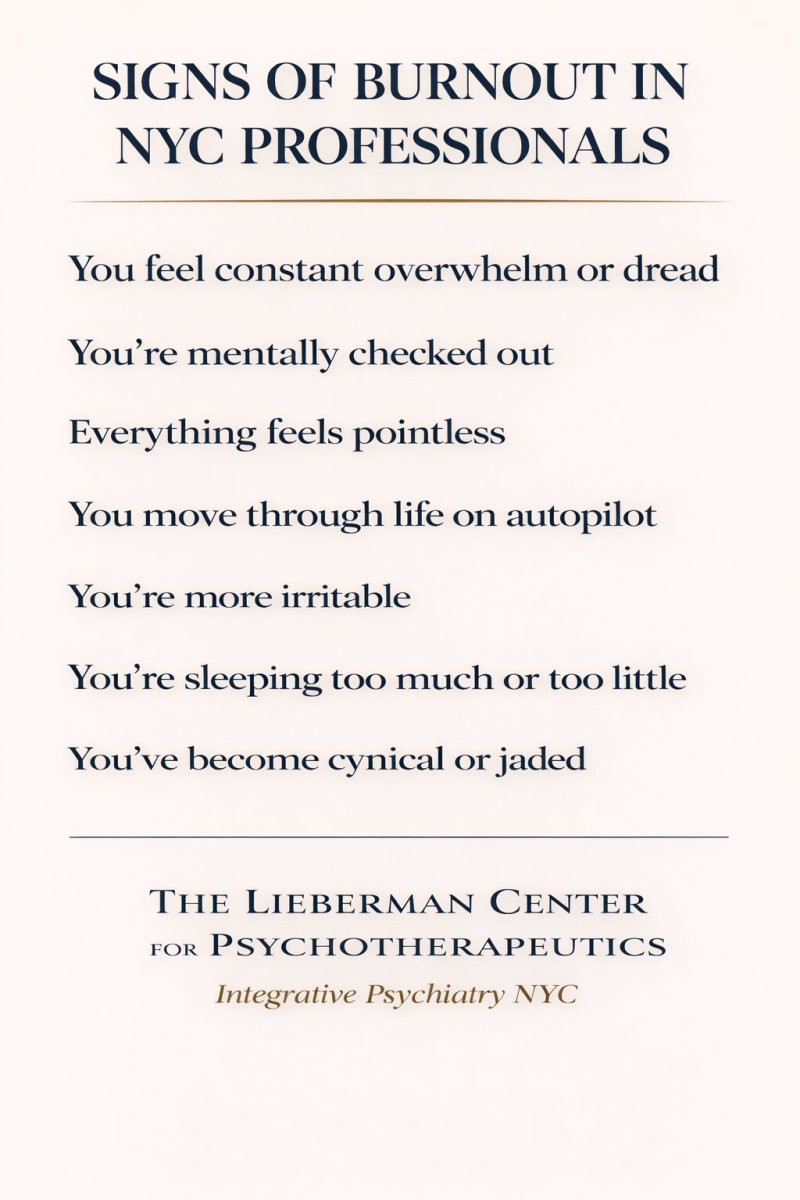
Here are 7 signs that can show up when high-performing people start to burn out, and how therapy for burnout in New York can help.
The Lieberman Center for Psychotherapeutics provides therapy for burnout in New York for high-achieving professionals who are looking for more clinically sophisticated care. Schedule a free consultation now.
You feel constant overwhelm or dread
Overwhelm can make your day feel heavier than it should. Even when the demands are familiar, you feel like you just aren’t up to it. You might notice a sense of dread, like a rock in your stomach, before your commute or as the week starts. Many people describe Sunday nights as the moment when the pressure hits hardest — the dreaded “Sunday Scaries.”
You’re mentally checked out
You may feel present physically but disconnected from what’s happening around you. You’re checked out. You doze off during conversations and meetings. You may still be getting done what you need to, doing the bare minimum, but you just can’t get yourself to truly care anymore.
Everything feels pointless
Burnout can make your priorities feel unclear. The projects you usually care about might feel meaningless. Your motivation can drop even if you used to feel strongly that the work you do matters. Many people describe this as losing their usual sense of direction. You’ve lost your purpose, and you’re not sure why you bother anymore.
You move through life on autopilot
Some people notice they’re completing daily living tasks automatically with very little internal engagement. You might get through your schedule without missing a beat, but you feel disconnected from every part of the day. Over time, this can make it harder to recognize what it is that you actually need.
You’re more irritable
Prolonged stress can reduce your emotional bandwidth. You may react more sharply to pressure because your system is already overloaded. Irritability can show up both at work and at home, which can affect your important relationships.
You’re sleeping too much or too little
Sleep changes are common with burnout. You might have trouble falling asleep because your thoughts feel nonstop, or you might sleep far longer than usual because you’re totally depleted. Either pattern can affect your concentration and productivity.
You’ve become cynical or jaded
When you’re burnt out, you tend to become cynical about work, your home life, or both. You may assume negative intentions more quickly or pull back from coworkers without meaning to. You might feel jaded about the future of your profession or your company.
How an NYC therapist can help you recover from burnout
Burnout isn’t a sign that you’re failing at your work, and it doesn’t mean you’ve reached the upper ceiling. Many high-achieving professionals in New York City interpret burnout as a sign that they should push harder and harder. But doing that usually only makes you feel even more exhausted.
Experiencing burnout also doesn’t necessarily mean that you have a mental health condition. Some people can develop anxiety or depression when the stress continues unaddressed (and that’s nothing to be ashamed of).
The good news is that burnout is completely manageable. You don’t need to do anything drastic like start a new career (although for some people, this can be part of the answer). With support, you can make changes that actually help you feel better instead of relying on willpower alone.
Psychotherapy for stress and burnout
Therapy for stress and burnout can help you identify the root causes behind your burnout and give you tools that match your needs. Different approaches work for different people.
Some examples of therapy methods that can help:
- Cognitive behavioral therapy (CBT)
- Acceptance and commitment therapy (ACT)
- Dialectical behavior therapy (DBT)
These methods focus on helping you manage strong feelings (like overwhelm and anxiety) and identify thinking patterns that could be unintentionally making you feel worse.
Stress management techniques
You can use stress management strategies at any time during your week, whenever you notice stress starting to build. It’s not just about “taking a deep breath.” Using these strategies physically calms your nervous system.
Examples of coping strategies you can use include:
- Breathing exercises that help lower your nervous system’s arousal level
- Grounding and mindfulness techniques that help your mind stay present
- Short recovery breaks, used strategically during the day, so your body isn’t running in a constant stress state.
- Guided relaxation methods like progressive muscle relaxation
Lifestyle changes
Certain patterns in your routine can lead to burnout (or make it worse) without you realizing it. Making simple lifestyle changes can often make a big difference, and a mental health professional can help you commit to them.
You might explore things like:
- Practicing good sleep hygiene to stabilize your sleep
- Changing your diet to make sure you’re getting the nutrition you need
- Getting regular exercise
- Making changes to your environment, like modifying your workspace or your schedule
Small adjustments often create more relief than people expect. But in some cases, you might feel like you need a bigger change (like changing careers) to get a handle on chronic stress. Therapy can help you explore all of your options and make sure you’re targeting burnout at its root.
Medications
Medication can help when burnout leads to symptoms that are too strong to manage with therapy and lifestyle changes alone. Some people notice significant improvement when things like sleep or anxiety levels become more stable.
Some examples of medications that might help include:
- Short-term sleep medications
- Antidepressants like SSRIs or SNRIs
- Stimulant medication (if a neurodevelopmental condition like ADHD is contributing to burnout)
- Anti-anxiety medications
Medication isn’t required for everyone, and on their own, they don’t get to the root cause. But meds can be one part of the plan, especially when symptoms have become more severe.
Take the first step. Start therapy for burnout in New York
You don’t need to wait for burnout to reach a crisis point to get help. When you work with an integrative psychiatrist who understands the pace of life in NYC, you get a plan that examines physical and psychological patterns that could be contributing to what’s going on. We look at your biology, your environment, your lifestyle habits, and more.
It’s entirely possible to regain stability without stepping away from the life you’ve worked hard to build.
If you’re ready to take the first step and get therapy for burnout in New York, reach out for a free consultation with an integrative psychiatrist at the Lieberman Center for Psychotherapeutics. We have convenient office locations in NYC, Long Island, and Westchester County.
Author: Brad Lieberman, PMHMP-BC, JD, MSN, is a board-certified psychiatric nurse practitioner providing integrative psychiatry in NYC. A former attorney trained at Columbia and Johns Hopkins, he brings analytical rigor and a level of advocacy and detail rarely found in mental healthcare.