

High achievement is widely admired in our culture. Elite performers, like executives and other high-ranking professionals, are often seen as disciplined and capable of handling intense pressure. All of that is true, and deserves to be admired.
But success does not make someone immune to mental health struggles and burnout.
Psychological research shows that there may be a hidden mental health crisis among these professionals. Many high-achieving people find themselves needing to operate under constant pressure to maintain their high performance and strong reputation.
Over time, that pressure can lead to chronic stress — and, in some cases, serious mental health concerns.
Having a mental health condition isn’t a sign of weakness, and it doesn’t mean you are any less deserving of your success. And just like most other health conditions, these issues can be effectively treated.
The Lieberman Center for Psychotherapeutics provides integrative psychiatry and therapy for executives in NYC. Schedule a free consultation now.
What is the psychology behind high achievers?
The psychology behind high achievers is complex.
A high-achieving personality is typically born from a combination of internal thinking styles and environmental pressures. Many of these traits can be adaptive, especially in moderation. They help you succeed.
But when they become extreme, they can also contribute to mental health challenges. Some high achievers may also set unrealistic goals or be driven by a deep sense of perfectionism and need to perform. In those cases, it can become unhealthy.
Below are some of the psychological patterns often associated with high achievers.
- Grit and persistence: Research shows that “grit” is a significant predictor of success. When you have grit, you’re able to persevere through hardships to fight for what you want. This trait often develops during adolescence.
- Growth mindset: Having a growth mindset means that you see setbacks as opportunities to grow and learn, rather than seeing them as failures. Research has shown that interventions that teach people to adopt a growth mindset may help improve achievement.
- Perfectionism: Perfectionism can help you reach your goals, but it can also be maladaptive. Striving for perfection, rather than excellence, can make you feel like you’re never “good enough .” Maladaptive perfectionism is linked to a number of mental health concerns, including low self-worth, anxiety, and obsessive-compulsive disorder.
- Social comparison: You may also be more likely to compare yourself against others, which can make you more competitive. This competitive spirit may motivate you to succeed, but it can also start eating away at your confidence.
Common mental health challenges faced by high achievers
Being a high-performing individual is generally a powerful strength. And this, in itself, doesn’t necessarily make you more vulnerable to mental health problems. But research does show that high achievers face unique risk factors that can lead to conditions like depression and anxiety.
The challenges faced by high achievers often look different from more “typical” mental health presentations. Many continue to perform at a high level, especially in their careers — even while experiencing serious emotional distress.
This can become a problem because your symptoms may stay hidden. It’s possible that no one notices that you need support. You might appear stable to others while privately experiencing mental health struggles. This can be incredibly painful and lonely.
Here are some common mental health challenges faced by high achievers and C-suite executives.
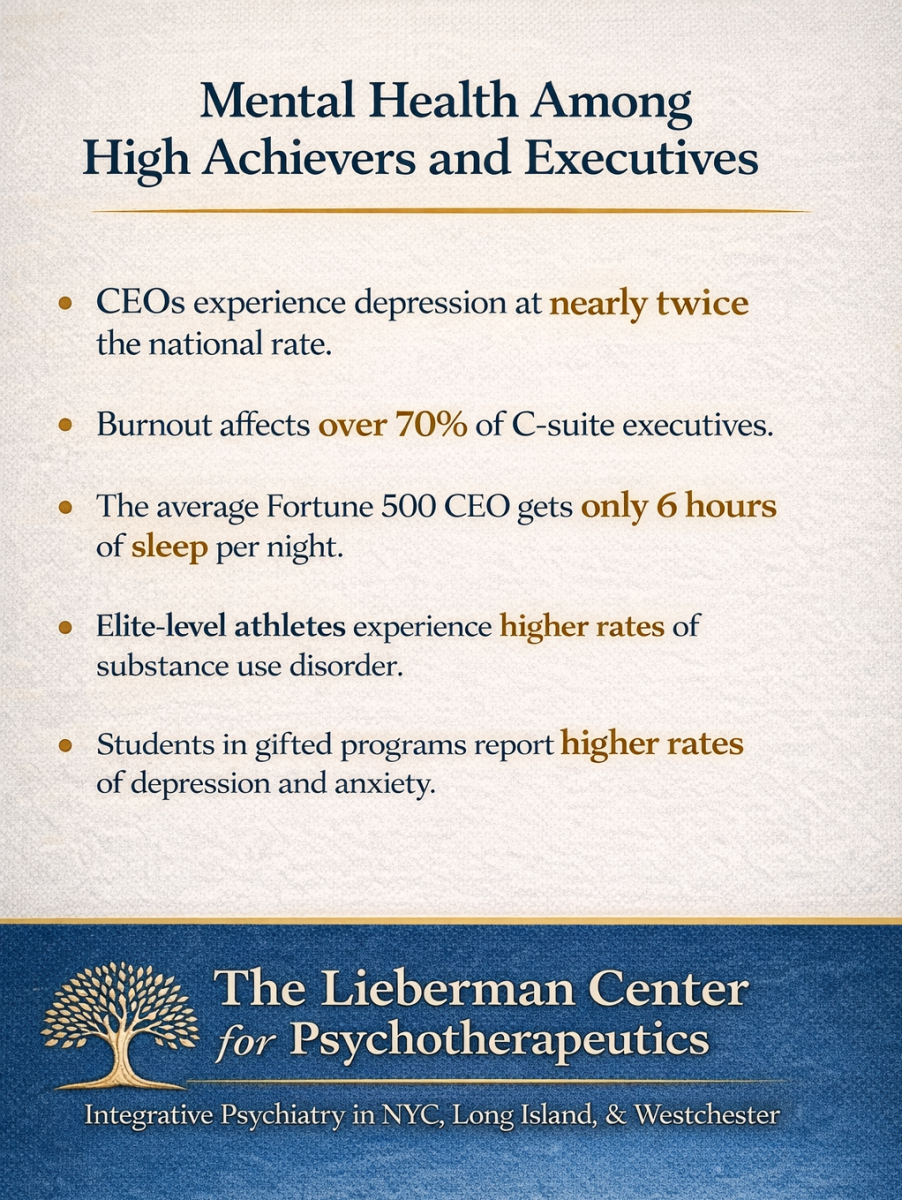
- Insomnia or other sleep difficulties, which is one of the most common mental health symptoms experienced by CEOs and other executives. The average Fortune 500 CEO only gets around 6 hours of sleep per night.
- Burnout or emotional exhaustion, which research shows affects over 70% of C-suite executives. Long hours and constant pressure contribute to this.
- Depression and a sense of emptiness. No matter how much you achieve, you may feel like your success is empty. You may sometimes find yourself wondering what the “point” of it all is. This could be called high-functioning depression, which means you’re still performing at a high level — but you’re suffering on the inside.
- Anxiety that gets worse during periods of intense pressure. For example, you might have money worries or performance anxiety, no matter how successful your life is. Anxiety can also show up as anger for some people.
- Imposter syndrome, where you doubt your competence despite objective success. Women and People of Color in positions of power are especially at risk for this, in large part because they’re often treated like they don’t belong.
- Perfectionism, or having unrealistically high standards for both yourself and those around you. It can be positive to set high standards. Striving for greatness helps you meet your goals, and it’s what sets many successful people apart. But being a perfectionist can harm your mental well-being.
- Lack of mental health support. Many high-achieving professionals feel reluctant to discuss emotional needs or seek help because of mental health stigma among their peers. Even if you believe in mental health awareness, you might still have fears — valid or not — that reaching out for support will hurt your career.
Are high achievers more prone to depression?
Studies show that high achievers have a high rate of depression compared with the general population.
Some reports suggest that CEOs experience rates of depression that are significantly higher than the national average. In certain surveys, the prevalence of depressive symptoms among executives has been estimated at nearly twice the national rate.
Youth in high-achieving schools are more likely to present with symptoms of anxiety and depression. Elite-level athletes are more vulnerable to multiple mental health problems, including substance use.
This doesn’t mean that being a high achiever directly causes mental health conditions, but the pressure to succeed can become a risk factor.
What is “high achiever syndrome”?
“High achiever syndrome” is not a clinical diagnosis recognized in psychiatry. But it appears often in discussions about mental health. The phrase describes unhealthy patterns, frequently observed among high-achieving individuals, which can be a double-edged sword.
People described as experiencing this “syndrome” often maintain exceptional performance while experiencing internal pressure or emotional strain. They may hold themselves to extremely high standards and feel overly critical of their own work.
Many high achievers describe a persistent belief that their accomplishments are never “good enough.” Even major achievements can feel temporary because the next goal quickly replaces the previous one.
Some common patterns associated with “high achiever syndrome” include:
- Intense achievement pressure to maintain success
- Difficulty recognizing accomplishments as meaningful
- Reluctance to slow down or prioritize self-care
- Emotional stress related to maintaining reputation
- Difficulty setting boundaries to protect mental well-being
New York integrative psychiatry tailored for high achievers and executives
High-achieving professionals need treatment and support that understands the unique challenges associated with their demanding careers. Leadership roles in fields like business, finance, medicine, law, and entrepreneurship come with very real stakes. It’s understandable to feel stressed at times, but if the pressure is starting to affect your mental wellness, then it may be time to get more support.
At the Lieberman Center for Psychotherapeutics, we help high achievers like you to understand mental health as a critical component of your overall well-being. We conduct a comprehensive evaluation, including psychiatric assessment as well as bloodwork and other testing, with the goal of treating your presenting symptoms at their root.
Treatment focuses on maintaining emotional well-being while continuing to pursue meaningful professional goals. We’re not here to tell you to quit your job. But integrative psychiatry and therapy can help you manage stress in healthy ways and learn how to balance your drive to succeed with your personal wellness.
Take the first step. Book a free consultation. Convenient office locations in NYC, Long Island, and Westchester County.
Author: Brad Lieberman, PMHMP-BC, JD, MSN, is a board-certified psychiatric nurse practitioner providing integrative psychiatry in NYC. A former attorney trained at Columbia and Johns Hopkins, he brings analytical rigor and advocacy to his patients’ mental healthcare.