

Most people use their insurance benefits to help pay for mental health support. But the fact is that the right therapist for you isn’t always in-network with your insurance. If you have strong out-of-network (OON) benefits, you may have more freedom than you think to work with the provider who’s best equipped to meet your needs.
But navigating out-of-network coverage can feel complex, and insurance companies aren’t likely to go out of their way to explain how to use it. That means people with excellent benefits sometimes don’t realize they can get top-tier care with significant reimbursement.
Here’s how out-of-network therapy works, what to weigh when making the decision to see an out-of-network provider, and the steps you need to take to make your healthcare benefits work for you.
How does out-of-network work for therapy?
Out-of-network coverage is straightforward in principle: your insurance plan will reimburse you for health services from a licensed provider who isn’t part of their contracted network. You pay the provider directly, submit a claim, and receive reimbursement for a percentage of the cost (once you’ve met your deductible).
But you might learn about out-of-network coverage and think, what’s the point of an insurance network to begin with?
Insurance networks exist to control costs. Insurers negotiate discounted rates with certain providers in exchange for sending them patients. Those agreements are financially beneficial for the insurer, but they also significantly limit the pool of providers you’re encouraged to choose from.
This system is designed to prioritize efficiency and cost management for the insurance company. In other words, it’s designed to work for them, not you.
The “purpose,” then, of out-of-network coverage is to give you a way to choose from outside of that narrow pool when it makes sense for your needs. It gives you a path to see the provider who’s right for you, regardless of what “network” they’re in – without paying the full cost yourself.
Having this type of flexibility can be particularly important in mental health care. Research shows that finding the right “fit,” and being able to build a strong therapeutic alliance, is one of the best predictors of good treatment outcomes in therapy. For many people, this matters a lot more than choosing a provider who falls within a “network” that an insurance company has drafted.
Out of network therapist: pros and cons
Seeing an out-of-network therapist can give you choice and control that in-network care often can’t match. But different things are right for different people, and as with most other things in life, there are trade-offs. Taking a balanced perspective helps you make the decision that’s right for you.
Here are the pros and cons of using your out-of-network benefits for mental health care.
Pros
- Wider provider choice: You can prioritize the provider’s skill, approach, and personality over network status. This means that you can choose the provider who is best-suited for your needs rather than just choosing from a limited list.
- More privacy: In-network providers often have to submit detailed session notes to insurers. With out-of-network care, those records stay within the practice, which reduces the risk of sensitive information being shared beyond your treatment team.
- Clinical autonomy: Treatment plans are made between you and your mental health provider, not dictated by an insurance representative – who often don’t understand what it takes to improve mental health.
- Potential cost coverage: Many plans cover between 30 and 100% of therapy costs (after deductible). For some people, this could be an even lower cost than their in network co-pay.
- Long-term value: Higher-quality therapy can produce better results in less time, which may offset higher per-session costs. Therapy is an investment, and working with the right provider can significantly impact your return.
Cons
- Upfront payment: You’ll need to pay the therapist’s full fee at the time of service, then seek reimbursement from your insurance plan later. So if you don’t have the financial stability to make this up-front payment, then it might not be for you.
- Deductible requirement: Out-of-network benefits usually apply only after meeting your OON deductible, which may be separate from your in-network deductible. Better insurance plans tend to have lower deductibles. This is something you’ll need to check for yourself.
- Partial reimbursement: Depending on your plan, you may still be responsible for a portion of the cost. (Keep in mind that even with an in-network provider, patients are typically responsible for copays.)
Difference between in-network and out-of-network
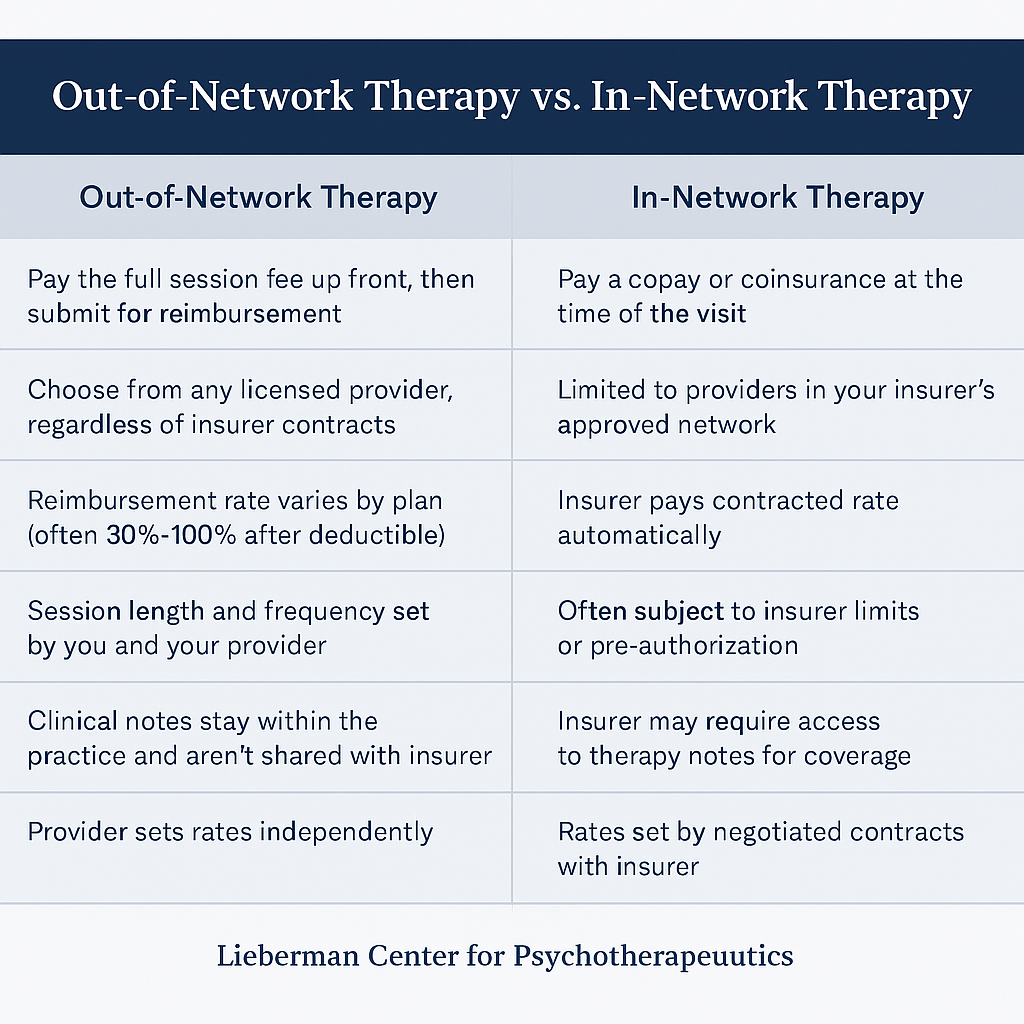
For many high-performing professionals, with financial stability and good insurance, the benefits outweigh the drawbacks.
Out-of-network therapy reimbursement rates
If you’ve never used out-of-network benefits before, you might not realize how much of your therapy costs could be covered. Every plan is different, but many reimburse between 30% and 100% of the allowed amount (once you meet your deductible).
A typical reimbursement might look like:
- High OON coverage plans — 70% to 100% reimbursement after deductible
- Moderate coverage plans — 50% to 70% reimbursement after deductible
- Minimal coverage plans — 30% to 50% reimbursement after deductible
At The Lieberman Center, we’ll run a benefits check for you before you start treatment so you’ll know exactly what percentage of your costs will be covered and what you can expect to pay out-of-pocket.
Steps to take to get reimbursed
If you’re considering using your out-of-network benefits for mental health care with us, here’s what to expect:
- Schedule a new patient discovery call: We’ll discuss your needs, answer questions about our approach, and explain how OON coverage works for your specific situation.
- Verify your benefits: We’ll work with Reimbursify to confirm your deductible, reimbursement rate, and allowed amount so you have a clear picture before committing.
- Begin therapy on your terms: You’ll set your schedule, session length, and treatment goals with your therapist. Your insurance company cannot interfere.
- Pay and submit claims easily: You’ll pay the fee directly at the time of service, and we’ll guide you through using Reimbursify to submit your claim in minutes.
- Track your reimbursements: You’ll be able to see when claims are processed and payments are issued, so there are no surprises.
Is it worth it to pay out of pocket for therapy?
Whether or not therapy costs are “worth it” is subjective. But for many people, working with the right provider is priceless – especially if your work, relationships, or overall quality of life are being negatively impacted by your mental health.
Therapy is not just another expense. It’s an investment in your ability to perform at your best, make sound decisions, and maintain the resilience you need to operate in a high-stakes environment.
When you pay up front for out-of-network therapy, you get access to a highly skilled professional whose sole focus is your progress, not insurance compliance. In many cases, having strong benefits means you’re not paying the full cost anyway. So it’s possible to get the best of both worlds: the therapist you want at the price you need.
Cutting-edge mental health treatment in New York & New Jersey
At The Lieberman Center for Psychotherapeutics, we work with high-achieving clients who expect their mental health care to match the quality and discretion they demand in other areas of life. Our clinicians provide advanced, evidence-based treatment without insurer restrictions. Your care plan should be guided by clinical need, not insurance companies’ cost-control policies.
If you’re ready to work with a provider who matches your standards, call 201-749-1414 to schedule a discovery call.