
When you’re dealing with major depression, one of the hardest decisions can be figuring out where to start feeling better. What’s better: therapy vs. medication for depression and anxiety? And how do you know which treatment is the right one for you?
The truth is, you don’t have to choose. Depression is complex, and what works best isn’t the same for everyone.Research shows that for many people, a combination of therapy and antidepressant medication is the most effective approach for major depressive disorder. But depending on your symptoms, preferences, and lifestyle, you might begin with one before adding the other.
Should I take an antidepressant or go to therapy?
Deciding between therapy vs. medication for depression isn’t just a medical question — it’s also a personal one. The National Institute of Mental Health says that treatment usually involves both, and that’s usually what’s most effective. But that might not always be the “right” choice for every person.
Some people prefer therapy because they want to understand what’s driving their depression. Others need faster relief to function in their daily life.
Therapy helps you examine your thoughts, habits, and relationships — it focuses on the psychological side of depression. Antidepressants, on the other hand, work biologically by balancing neurotransmitters like serotonin and dopamine that influence mood and energy.
If your symptoms are mild to moderate, or you’re interested in addressing root causes, therapy can be a powerful place to start. If your depression is more severe — for example, you’re struggling to get out of bed or keep up with work — medication can stabilize your symptoms enough to make therapy more effective later on.
In many cases, combining the two is the way to treat depression. You can always start small, assess how you respond, and adjust over time.
Benefits of therapy
Therapy is one of the most well-established treatments for depression. Dozens of large studies have shown that psychotherapy can reduce symptoms of depression and improve long-term outcomes.
But effectiveness isn’t usually the only factor involved when people are making this decision. Some of the other, more real-world benefits of therapy for depression are:
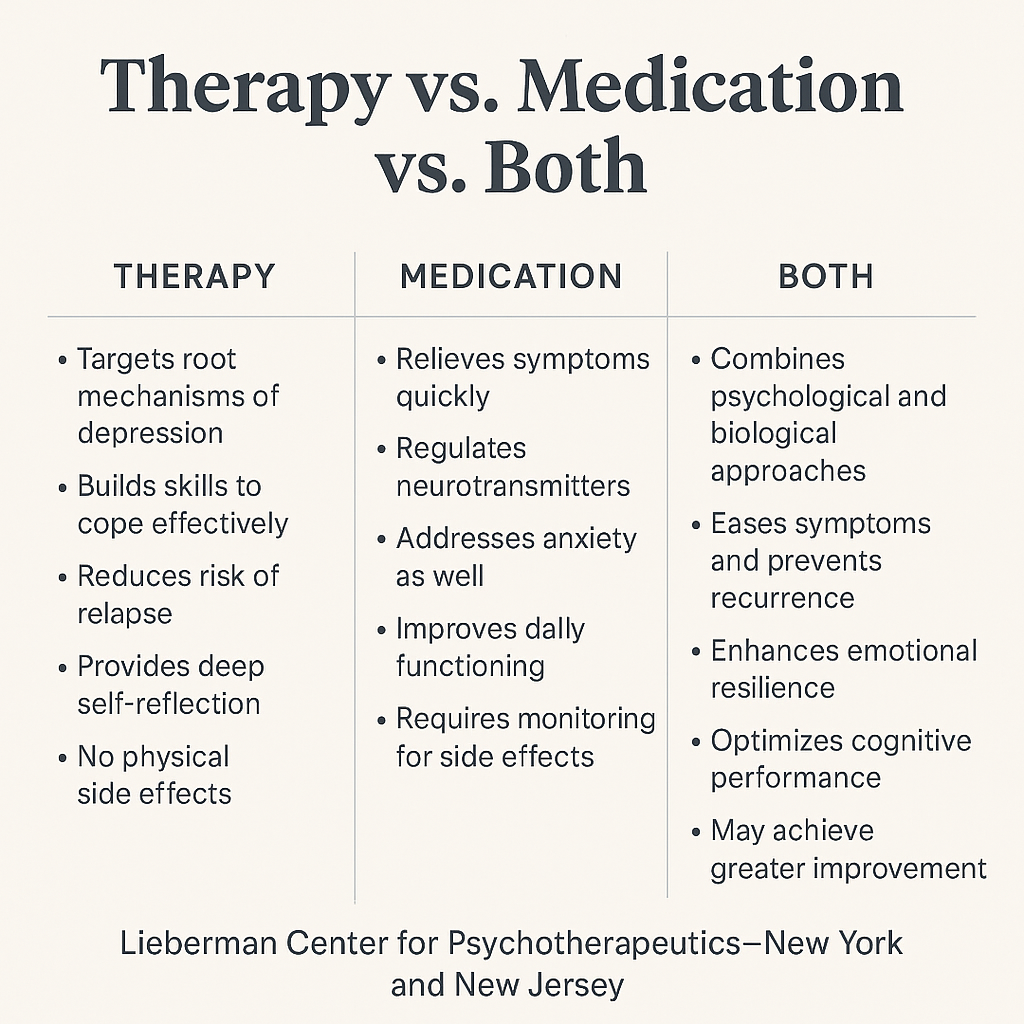
- It addresses root causes. Therapy helps you identify the thought patterns, emotions, and life experiences that fuel your depression.
- It teaches coping strategies. Cognitive-behavioral therapy (CBT) and other forms of psychotherapy (such as interpersonal psychotherapy) can help you manage the daily stressors that make depression worse.
- It reduces relapse risk. Research has found that people who completed cognitive behavioral therapy were less likely to relapse compared to those who only took medication.
- It improves emotional insight. You develop a better understanding of yourself — how your early environment, perfectionism, or burnout might play into how you feel now.
- It has no physical side effects. Unlike medication, therapy doesn’t alter brain chemistry or carry physiological risks.
For many professionals, therapy can also be a confidential space to process high-pressure environments, long work hours, and the personal costs of success.
Benefits of antidepressant medication
But antidepressant medication can also play a critical role in treatment, especially for people with moderate to severe depression or depression that’s lasted a long time.
Here are some of the benefits of medication for depression:
- It relieves symptoms quickly. Antidepressants can improve mood, concentration, sleep, and appetite within weeks. Sometimes, you may not have the time to wait for therapy to start becoming effective.
- It regulates brain chemistry. These medications work by adjusting serotonin, norepinephrine, and dopamine levels — neurotransmitters that influence mood and motivation. Sometimes, this is what you need.
- It supports co-occurring anxiety. Many people with depression also experience an anxiety disorder. Certain antidepressants can address both conditions.
- It helps you function. When symptoms make it hard to think clearly or complete tasks, medication can help you get your mental energy back.
- It creates a foundation for therapy. For many people, medication provides the stability needed to participate fully in psychotherapy.
Medication may cause some side effects. But most are temporary and mild, and manageable with close monitoring from a psychiatrist. Antidepressant medication isn’t necessarily meant to be a permanent fix. It’s a treatment tool that can help you feel well enough to do the deeper work of therapy.
What is the best treatment for depression?
Research overwhelmingly shows that the best depression treatment is a combination of psychotherapy and antidepressant medication. Studies comparing cognitive therapy and pharmacotherapy consistently find that combining the two produces better results than either alone. In other words, you don’t need to make the choice.
Medication can help regulate mood and energy so you can function again, while therapy helps you understand yourself and prevent relapse. For some people, medication is temporary — something you take to stabilize depression symptoms while you build coping skills in therapy.
For others, it becomes part of ongoing care — and that’s okay, too.
You might also move between treatments as your needs change. For example, if therapy isn’t improving symptoms after a few months, adding medication could help. If you start with antidepressants, introducing talk therapy later can keep you on the track toward recovery.
The key is flexibility. Depression treatment isn’t one-size-fits-all. It’s an evolving process that should fit your goals, not the other way around.
Integrative psychiatry in NYC
If you’re dealing with depression, you’re not alone. Many high-functioning professionals maintain success at work but quietly struggle with low motivation, fatigue, or a sense of emptiness. When you’re used to pushing through stress, it can be difficult to admit that something deeper might be going on.
Whether you choose medication or therapy (or both), there is a way out of this.
At the Lieberman Center for Psychotherapeutics, we specialize in working with executives, founders, and other high-performing professionals who experience depression and anxiety. Our team provides integrative psychiatry, including psychotherapy and medication management as well as genetic testing and more, to help you make informed choices.
If you’ve been living with depression, even while performing at a high level, you don’t have to just push through it. Let us help — schedule a free discovery call today.