

Your mental health matters, both at work and in your personal life. You’re looking for the best, most effective support. You might have heard the term “integrative psychiatry” and dismissed it as too “woo woo” for you. You’re looking for science-backed treatment, not crystals or pseudoscience.
But integrative psychiatry is so misunderstood. It’s not “woo woo” at all — in fact, it’s just the opposite. It’s about integrating the strongest evidence from various fields of medicine to create a more comprehensive, precise, and effective approach to mental health treatment. If you’re tired of short-term fixes and band-aid solutions, we can help.
The Lieberman Center for Psychotherapeutics provides evidence-based integrative psychiatry in NYC, Long Island, and Westchester for high-achieving professionals looking for more clinically sophisticated care. Schedule a free consultation now.
What is integrative psychiatry in NYC?
Integrative psychiatry is an approach to mental health treatment that combines research from different scientific fields. A conventional provider might just take a tally of your presenting symptoms and prescribe medication. And for some people, that works.
The problem is that for many people, it doesn’t. Most people don’t find the right medication and dosage right away. It takes a prolonged process of trial and error. You might feel like you’re “winging it” without a clear sense of direction, and relying on band-aid solutions rather than a targeted treatment plan.
Integrative psychiatry was developed to address that gap. Instead of treating symptoms in isolation, this approach focuses on understanding why symptoms are happening and how different systems in the body may be contributing.
What does an integrative psychiatrist do?
An integrative psychiatrist combines conventional psychiatric care with evidence-based complementary approaches to create a more comprehensive and personalized treatment plan.
What is the difference between integrative and functional psychiatry?
Both focus on root causes, but integrative psychiatry places greater emphasis on psychiatric training, medication management, and psychotherapy alongside holistic strategies.
What are the benefits of integrative psychiatry in mental health treatment?
This approach offers a more structured and comprehensive way to approach psychiatric care, which is often especially helpful for people with complex or persistent symptoms. Here are some of its main benefits.
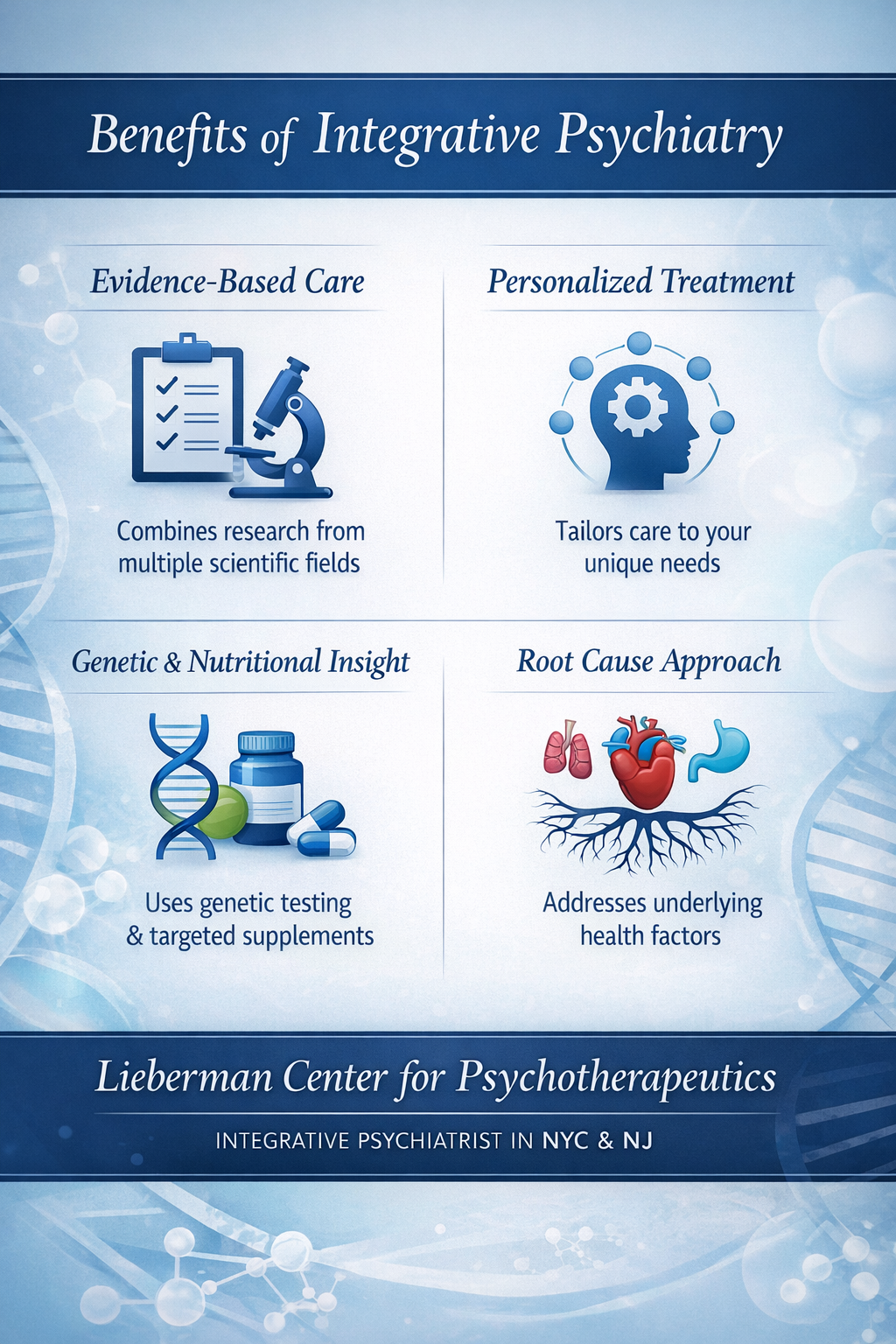
Uses top evidence-based practices from various scientific areas
One of the primary benefits is that it combines research and best practices from different areas of medicine. Clinical trials have shown us that although medication can be incredibly helpful, it’s not the only thing that works.
This approach is not about replacing medication. This is a myth. Psychiatric medication remains a key part of integrative psychiatric services when evidence supports its use. What changes is how medication is selected and supported.
In addition to medication, we might use other science-based treatment methods like:
- Psychotherapy and counseling methods like motivational interviewing to strengthen commitment to treatment and improve follow-through (medication won’t work if you don’t take it as prescribed)
- Physical exercise, which research has shown repeatedly helps to significantly reduce depression and anxiety as well as improve overall wellness
- Nutritional supplementation, since being deficient in different vitamins and minerals can make mental health problems worse; integrative psychiatrists can prescribe the right supplements to help your brain work at its best
- Genetic testing, which can provide insight into how your body metabolizes medications and which psychiatric medications you may be more likely to tolerate or respond to
Comprehensive evaluation to address root causes
Integrative psychiatrists address mental health problems from a holistic, root-cause level. It’s not just about what you’re experiencing right now. It’s about all of the other lifestyle factors, medical history, and more that have contributed to your feeling this way.
For example, if you aren’t able to sleep at night, we’d perform a comprehensive evaluation to determine what other factors are linked to the insomnia. Evaluation may include factors such as inflammation, gut health, stress physiology, stimulant intake, or underlying anxiety patterns.
All of these elements can interact in ways that intensify psychiatric symptoms over time. It’s not just about slapping a sleep aid on the problem and hoping for the best (although sleep aid medication can be helpful). It’s about looking deeper into all of the different factors that are playing a role, and addressing the root causes.
Collaboration with other treatment providers
Integrative psychiatrists can work and communicate with other healthcare providers you’re already seeing — such as primary care physicians, specialists, or mental health therapists — to better understand the full picture of your health.
This concierge-style approach allows psychiatric care to align with other medical treatment, rather than existing in a vacuum. When providers are communicating, treatment decisions are more cohesive. Every provider better understands your needs on a holistic level.
This kind of coordination can be especially helpful when mental health symptoms overlap with medical conditions or symptoms like chronic pain. With your signed permission, an integrative psychiatrist can consult with other practitioners and incorporate that information into a more comprehensive treatment approach.
Reduces depression, anxiety, and more
Perhaps the most important benefit is that it works for reducing mental health symptoms like depression and anxiety. It focuses on using science and interventions that have been shown to be effective, rather than relying on trial-and-error alone.
By drawing from psychiatric research and careful evaluation, this approach helps take the guesswork out of treatment and replaces it with data-informed decision-making. We have a clear, science-backed rationale for every recommendation.
How to connect with an integrative psychiatrist near you
If you’re interested in working with an integrative psychiatrist, start by reviewing the provider’s training and clinical philosophy. Look for a practitioner who emphasizes comprehensive evaluation, evidence-based care, and collaboration with therapy when appropriate.
It’s also important to ask about appointment structure. Integrative psychiatry often involves longer intake sessions and more in-depth follow-ups, which allows time to develop a personalized treatment plan rather than rushing decisions.
Finally, consider how the provider coordinates psychiatric care with complementary and conventional approaches. Ask about how their model prioritizes long-term well-being over quick fixes.
Does insurance cover integrative medicine?
Coverage varies by provider and plan, and some integrative psychiatric services may be out-of-network or partially covered depending on the evaluation and treatment provided. At the Lieberman Center, we believe in the benefits of out-of-network mental health care.
Work with an integrative psychiatrist in NYC
The Lieberman Center for Psychotherapeutics offers integrative psychiatry in NYC and surrounding areas. We use a concierge model of medicine designed for precision and personalization. Initial evaluations are 90 minutes, allowing for a thorough psychiatric assessment, while follow-up sessions are 30 minutes. Our goal is to understand what’s at the root cause of your symptoms and to address them through an integrated, evidence-based treatment approach.
Get in touch with us today to schedule a discovery call. We have convenient locations in NYC, Manhasset, and Scarsdale.